I had a huge quantity of frog spawn laid in my pond a couple of weeks ago, a bit later than usual. I thought that as it was so late it would be safe from frost for a change. The unexpected severe frost and snow has damaged it but I still hope to have plenty of tiny froglets to hop around my garden. MyJapanese contorted cherry tree is full of thousands of tiny flowers, usually covered in bumble bees, but it is too cold for the bees to venture out. In fact, a few weeks ago with Spring looking near, butterflies had started to emerge. It is difficult times for the wildlife. I had an old feather pillow which had burst open so I let the feathers blow onto my lawn. Today I have spotted a sparrow filling its beak with them to line a nest. I make sure that I don't hang my washed cashmere and Llama fibres outside at this time of year. I am sure that they would be most appreciated as bedding for nestlings, but it is a bit too precious for that.!
I am a textile artist living in the Isle of Man. I live on a farm which provides plenty of inspiration and resources for my craft. I am a mixed media artist and love to experiment but I do have a particular love for working with plant dyed fibres. The dyes are prepared using the vast amount of material in my forest garden. The garden is primarily a wildlife refuge but also supplies abundant food, medicines and photographic opportunities. Contact me at pat.rhaa@gmail.com
Friday, 29 March 2013
Cathedral Window
I had a huge quantity of frog spawn laid in my pond a couple of weeks ago, a bit later than usual. I thought that as it was so late it would be safe from frost for a change. The unexpected severe frost and snow has damaged it but I still hope to have plenty of tiny froglets to hop around my garden. MyJapanese contorted cherry tree is full of thousands of tiny flowers, usually covered in bumble bees, but it is too cold for the bees to venture out. In fact, a few weeks ago with Spring looking near, butterflies had started to emerge. It is difficult times for the wildlife. I had an old feather pillow which had burst open so I let the feathers blow onto my lawn. Today I have spotted a sparrow filling its beak with them to line a nest. I make sure that I don't hang my washed cashmere and Llama fibres outside at this time of year. I am sure that they would be most appreciated as bedding for nestlings, but it is a bit too precious for that.!
Thursday, 21 March 2013
February and March U3A
Christopher gave us a spellbinding talk and slideshow about plants seen on one of his trips to South Africa. In particular the photographs were taken in the Fynbos a natural shrubland or heathland in a small area of the Western Cape.The word Fynbos means Finebush. It covers 0.08% of the world's surface but has 3% of the world's flowers. some of the plants he showed in his photographs were Proteas, Heathers and Buchu, the latter cultivated for their essential oils which have medicinal properties. Hottentot tea, the Coral bean tree and Euphorbias were also shown. The wood from Camphor trees is used to make chests to store blankets as it protects against moths.
PlantZAfrica is a useful website to learn more about the indigenous flora of that region.
In the March meeting I gave a description of plants that are perennials but which many people do not know are edible. I shall be trialing out various ones and keeping you posted on what I think of them.
Useful books on the subject are: How to Grow Perennial Vegetables and Creating a Forest Gardening both by Martin Crawford of the Agroforestry Research Trust. He has an excellent website where you can purchase trees, plants and seeds. You can find it at agroforestry.co.uk
PlantZAfrica is a useful website to learn more about the indigenous flora of that region.
In the March meeting I gave a description of plants that are perennials but which many people do not know are edible. I shall be trialing out various ones and keeping you posted on what I think of them.
Useful books on the subject are: How to Grow Perennial Vegetables and Creating a Forest Gardening both by Martin Crawford of the Agroforestry Research Trust. He has an excellent website where you can purchase trees, plants and seeds. You can find it at agroforestry.co.uk
Spring nibbles
I am busy in the greenhouse at present sowing my new batches of seed, always an exciting time.

I have also been using some of the new spring growth for eating. One of the main plants that I eat at this time of year is Alexanders. It grows along the roadside in the Isle of Man but I have a well established patch outside the door of the greenhouse. I use the leaves chopped up in salads and also in stir fries or as a steamed vegetable. It has a slight celery taste if slightly oily. I use it in bulk as it grows so luxuriantly. In fact, because of the mild winter we have had I have been using it for the past four months, and it has not suffered in the heavy frosts we had last week. It produces large black seeds in the summer which apparently can be ground up as a pepper but I have not tried that yet.
Previously I have nibbled on the flowers of Columbine while walking round the garden, they are very sweet, but today I tried eating the leaves. They are my new favourite leaf to eat, peppery to begin with but followed by a lingering sweetness. Above left Alexanders right Columbine.
I purchased a Hemerocalis plant last year (Day lily} and am intending to get a clump of them established, slugs permitting. The flowers are edible. Pick the buds in the morning and flowers at the end of the day. They have thick, sweet, crunchy petals which provide good substance in a salad where they are eaten raw. They can also be battered and deep fried or stuffed. The buds taste like French beans.
Soon it will be time to try out some emerging shoots such as hops and bamboo. The young shoots of hops are like asparagus and can be cooked slightly and used with a sauce if so desired. The shoots of bamboo are cut close to the ground and split to reveal the tender core. This can be then stir fried in many different dishes. Cutting the emerging shoots also prevents unwanted spread.
I have also been using some of the new spring growth for eating. One of the main plants that I eat at this time of year is Alexanders. It grows along the roadside in the Isle of Man but I have a well established patch outside the door of the greenhouse. I use the leaves chopped up in salads and also in stir fries or as a steamed vegetable. It has a slight celery taste if slightly oily. I use it in bulk as it grows so luxuriantly. In fact, because of the mild winter we have had I have been using it for the past four months, and it has not suffered in the heavy frosts we had last week. It produces large black seeds in the summer which apparently can be ground up as a pepper but I have not tried that yet.
Previously I have nibbled on the flowers of Columbine while walking round the garden, they are very sweet, but today I tried eating the leaves. They are my new favourite leaf to eat, peppery to begin with but followed by a lingering sweetness. Above left Alexanders right Columbine.
I purchased a Hemerocalis plant last year (Day lily} and am intending to get a clump of them established, slugs permitting. The flowers are edible. Pick the buds in the morning and flowers at the end of the day. They have thick, sweet, crunchy petals which provide good substance in a salad where they are eaten raw. They can also be battered and deep fried or stuffed. The buds taste like French beans.
Soon it will be time to try out some emerging shoots such as hops and bamboo. The young shoots of hops are like asparagus and can be cooked slightly and used with a sauce if so desired. The shoots of bamboo are cut close to the ground and split to reveal the tender core. This can be then stir fried in many different dishes. Cutting the emerging shoots also prevents unwanted spread.
Sunday, 17 February 2013
Llama and angora goats
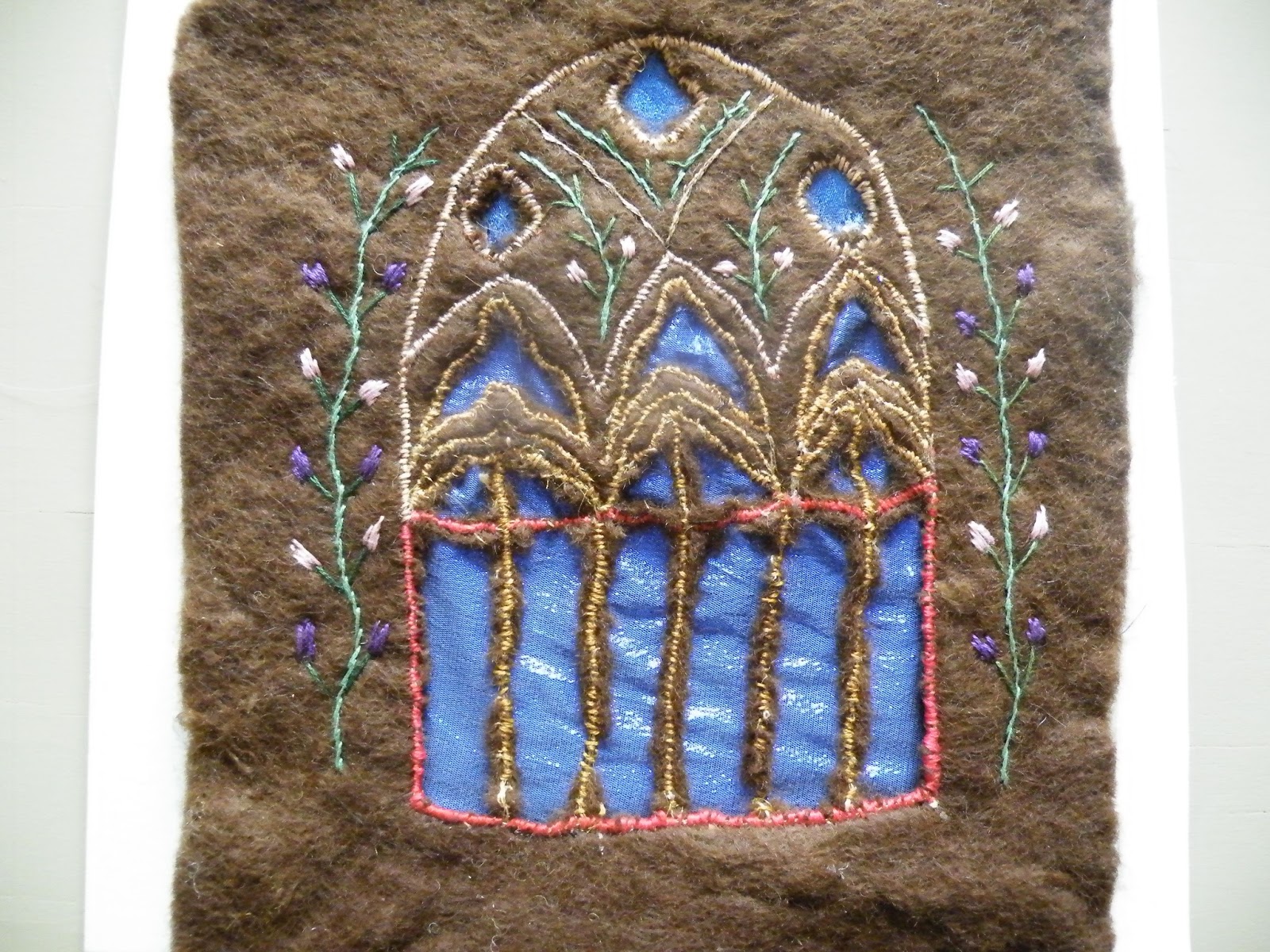
I have been felting some Llama fibres that I was given. Some of them were white and the ones that I am using at present are a rich dark ginger colour. I am working on felted textiles based on the architecture of Peel Cathedral on the Isle of Man. I have done a small piece of work as a trial. After felting the Llama fibres I cut away areas for the windows and hand stitched around them and added floral decoration. The felting was very easy and produced a very smooth, lustrous finish.
Today I tackled a very large felting, again with Llama fibres. It is about three feet long. I laid out the fibres in three layers and then hand stitched them between lace curtain fabric to hold them in place.
I then laid it out on the floor of the bath, turned on the shower and sprinkled a solution of olive oil soap over. I then threw it onto the floor of the bath 100 times. After that I took the felt out of the nets, checked on the level of felting, and threw it again another 100 times. I am now going to produce a larger version of the cathedral window and will put something like organzas behind the cut out areas to represent stained glass.
I went to see a lady this week who has started to breed Angora and Boer goats, the Boer is for meat and the Angora to produce Mohair. I bought an Angora fleece and am looking forward to using my natural dyes on it. The mohair is beautifully soft and lustrous with lovely curls.
To find out more about Llamas visit the British Llama Society website. Visit the British Angora goat society and British Mohair marketing to find out more about Angora goats. I will post some photos in a few weeks of my finished textiles.
I have also been dyeing calico, wool and threads with a mix of coffee grounds, tea bags and onion skins, basically kitchen leftovers. I heated the dye pot for a few minutes and then put the fibres and materials in the dye pot and left it for a few days. I repeated this using the same dye bath and obtained a variety of strengths of colour until the dyes ran out. I have materials and threads now in a variety of browns/ginger to use in different projects.
To find out more about Llamas visit the British Llama Society website. Visit the British Angora goat society and British Mohair marketing to find out more about Angora goats. I will post some photos in a few weeks of my finished textiles.
I have also been dyeing calico, wool and threads with a mix of coffee grounds, tea bags and onion skins, basically kitchen leftovers. I heated the dye pot for a few minutes and then put the fibres and materials in the dye pot and left it for a few days. I repeated this using the same dye bath and obtained a variety of strengths of colour until the dyes ran out. I have materials and threads now in a variety of browns/ginger to use in different projects.
Friday, 18 January 2013
fire 2
This was my entry into the Fire competition at the Hodgson Loom Gallery. I won the prize in the 2D mixed media category. The embroidery resulted from a photograph I took early one morning a few years ago, of a close up of one of the trees in our field. This was bonded upside down onto a bamboo cleaning cloth ( Yes, the ones you are supposed to use for dusting!). Bamboo fabric has the feel and lustre of silk. The white paper on the back of the printout was then rubbed away mostly with a sponge. More of it than I intended was removed so I then worked inktense pencils and sepia pen into certain areas. The whole was then stitched using stranded cotton in a Kantha stitch.
The U3A herb group met on Wednesday. Three of our members did short presentations. Jenny did one on herbs used by North American Indians and gave us some beautiful print outs. Sandi told us the fascinating history behind recently discovered illuminated manuscripts in which cats are depicted wearing medieval clothing and there are borders of herbs and flowers surrounding them. At a later date we are going to try to work out which plants are illustrated. Lesley talked about the myths behind some of the herbs used by ancient Greeks and Romans. I gave a short talk about knot gardens which led to discussion about box blight and alternative herbs that we could use as edging plants.
We also exchanged information about seed catalogues and discussed possible venues for visits in the spring and summer.
The U3A herb group met on Wednesday. Three of our members did short presentations. Jenny did one on herbs used by North American Indians and gave us some beautiful print outs. Sandi told us the fascinating history behind recently discovered illuminated manuscripts in which cats are depicted wearing medieval clothing and there are borders of herbs and flowers surrounding them. At a later date we are going to try to work out which plants are illustrated. Lesley talked about the myths behind some of the herbs used by ancient Greeks and Romans. I gave a short talk about knot gardens which led to discussion about box blight and alternative herbs that we could use as edging plants.
We also exchanged information about seed catalogues and discussed possible venues for visits in the spring and summer.
Wednesday, 9 January 2013
Fire
The
theme of the annual competition at the Hodgson Loom Gallery this year is fire.
I was struggling with my entries as the colours of fire are a lot brighter than
those that I usually work with. I like to research widely before I
begin a new textile piece and this led me to study Native American fire symbols
and I was also attracted to images of the Lightning bird. I originally was
going to work one large felted area with hand and machine stitching. Much of
the wool used in the felting was from local Jacob's sheep, incorporated with
other plant dyed wools. The wools were mainly dyed with Dyer's chamomile
flowers from my garden which I put in a flask with alum mordanted wool. Due to
the unusually warm weather we have been having. The chamomile has been
flowering for many months, so I keep picking them and drying them on the
windowsill. I started to machine stitch on the resulting felted area
but did not like it. If in doubt I can be quite radical, so I cut the felt into
small squares. On each square I hand embroidered a North American Indian sun
symbol. A large piece of yellow dyed wool was then felted separately and on
this I hand stitched a colourful lightning bird, The whole lot was then laced
together over a piece of orange organza.
Wednesday, 5 December 2012
mixed herbs
We had a small Christmas party at the U3A herb group and I also gave a short introductory presentation on the basics of garden design. We ate a selection of herbal foods including some fabulous scones cooked by the owner of the Pavillion restaurant in Laxey where we meet. Two sets of scones were made using herbs from our member's gardens; they were Lemon Verbena with almond topping and Oregano, Thyme with red onion-they tasted great on their own or with butter or jam. Other members cooked-small herb omelettes-lavender biscuits-rosemary and currant biscuits and I brought along a mixed herb salad.
Myself and Sheena Quayle who had an joint exhibition this year at the Hodgson Loom Gallery in Laxey have an article in Be Inspired which is the first annual brought out by the national stitching magazine, Workbox. It is a very fine publication, the Workbox team who took over a failing magazine have turned it into one relevant to present day textile artists. I especially love the fact that it often features articles on fibre art. One of the pieces of my work featured in the magazine is called Byzantine Cross which is based on a cross that held a relic in its central portion. I made some paint with soil dug from the bottom of a post hole that my husband was working on. This was subsoil so it had a beautiful ochre colour which I then mixed with gum arabic to make the paint which was then applied to paper and distressed by rubbing to give an aged appearance. Beads and plant dyed silk thread were sewn on to a cross shaped area cut from this paper and the whole lot was stitched on to black velvet.
Subscribe to:
Posts (Atom)
